


 UK Registered Doctors
Retatrutide scientific and clinical summary
- Overview of retatrutide
- How retatrutide works
- Rationale for glucagon receptor agonism
- Clinical evidence
- Safety, practical considerations and regulatory status
- Potential role in obesity treatment
A plain-English glossary of the technical terms used in this document can be found at the end of the article.
Overview of retatrutide
Retatrutide (LY3437943) is an experimental medicine being developed by Eli Lilly for obesity and related metabolic disease. Like semaglutide and tirzepatide, it is a peptide drug given by injection. What makes retatrutide different is that a single molecule has been engineered to activate three hormone receptors at the same time: GIP, GLP-1 and glucagon.1,2 It is therefore often referred to as a ‘triple agonist’.
Retatrutide is being developed by Lilly as a once-weekly subcutaneous injection. As of September 2026, it remains investigational and has not been approved by any regulatory authority, although several large Phase 3 trials have reported positive results.1,4,6
The idea behind retatrutide is straightforward, even if the underlying biology is complex. GLP-1 and GIP activity—as seen with tirzepatide (Mounjaro®)—can reduce appetite and improve glucose control. Retatrutide adds glucagon receptor activity, which may increase energy expenditure and influence the way the body handles fat. In this way, the drug is designed to promote weight loss through several complementary mechanisms rather than relying on appetite suppression alone.
The results so far have attracted a great deal of attention. In the highest-dose groups, average weight loss has been substantially greater than that reported in trials of earlier GLP-1 medicines. This has led to discussion about whether pharmacological treatment could, for some people, approach the degree of weight loss traditionally associated with bariatric surgery.
How retatrutide works
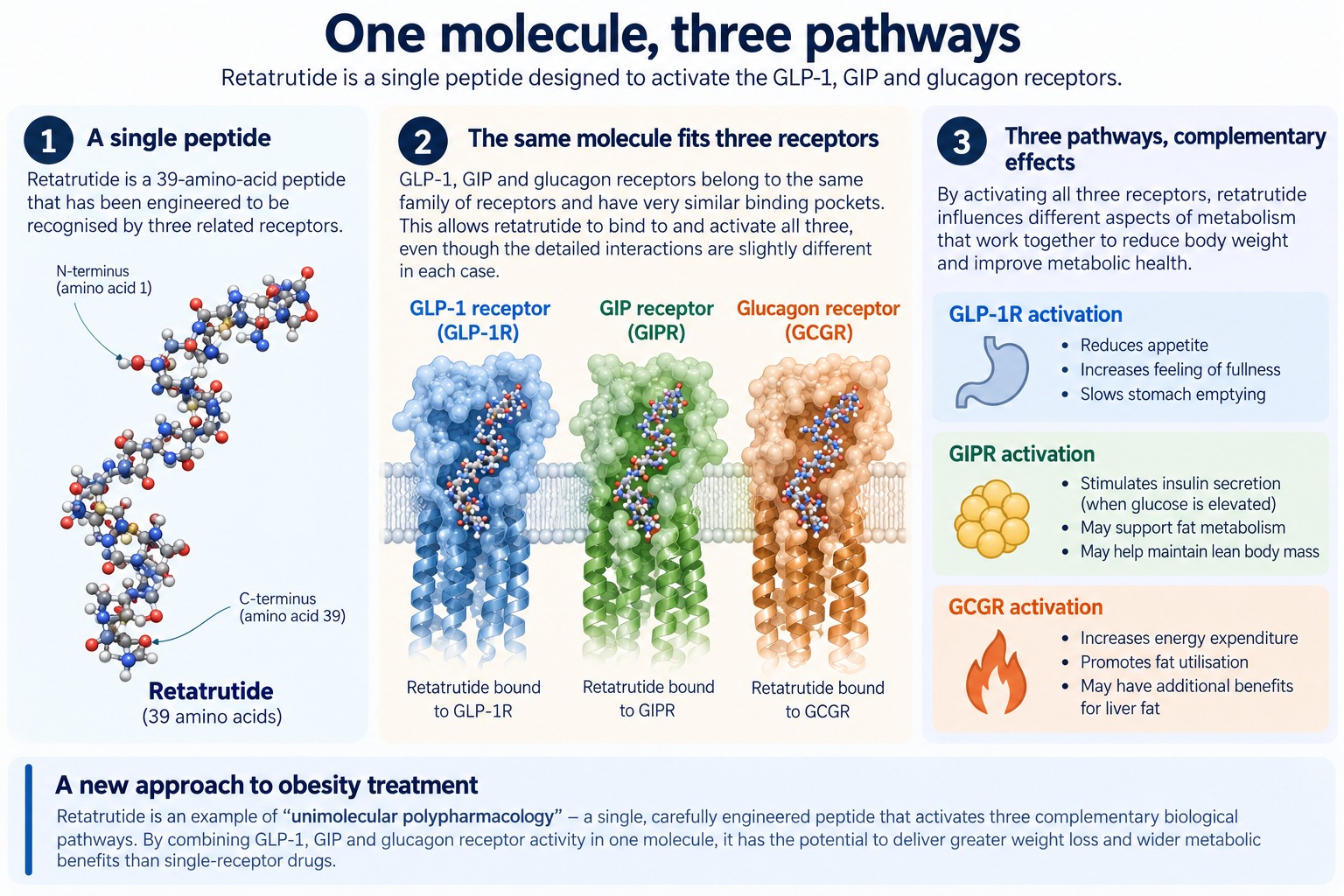
Retatrutide is a single engineered peptide designed to activate three closely related hormone receptors: GIP, GLP-1 and glucagon. Rather than combining three separate drugs, one molecule is able to stimulate all three pathways. Together, these receptors influence appetite, blood-glucose control and energy metabolism, giving Retatrutide the potential to promote weight loss through several complementary mechanisms (Figure 1).
- GLP-1 is the most familiar part of the story. Activating the GLP-1 receptor reduces appetite and food intake, slows stomach emptying and helps the pancreas release insulin when blood glucose is raised. These are the same broad effects used by medicines such as semaglutide.
- GIP is the second component. It also supports glucose-dependent insulin release and appears to work well alongside GLP-1 in controlling appetite and body weight. Tirzepatide, which activates both GIP and GLP-1 receptors, showed just how effective combining these two pathways could be.
- The third component is glucagon, and this is what makes retatrutide particularly interesting. Glucagon is most familiar as a hormone that helps raise blood glucose when levels fall. However, its effects extend beyond glucose regulation: it also influences energy expenditure, the release of fat from stores and the use of fat as a fuel.
As with many drugs that act on several biological pathways, the challenge is finding the right balance. Excessive glucagon activity could oppose some of the glucose-lowering effects of the treatment. Retatrutide is therefore designed to provide enough glucagon receptor activity to capture its metabolic benefits, while preserving the favourable effects of GIP and GLP-1 on appetite and glucose control.
Like other peptide drugs in its class, retatrutide has been modified to remain active in the body for long enough to allow once-weekly dosing. As with other peptide incretin medicines, it is given by subcutaneous injection rather than as a conventional tablet.
Rationale for glucagon receptor agonism
Adding glucagon activity to an obesity medicine can sound counterintuitive at first. Glucagon is a hormone that raises blood glucose, so why would anyone deliberately stimulate its receptor in people who are overweight or obese, particularly when many may also have type 2 diabetes?
The explanation is that glucagon does more than raise blood glucose. It can also increase energy use and encourage the body to release and burn stored fat. GLP-1 works mainly by reducing appetite and food intake, while GIP helps stimulate insulin release and may also have effects on appetite and fat metabolism.
Taken together, these effects provide the rationale for combining the three pathways in a single molecule. In principle, a balanced triple agonist could reduce energy intake while also increasing energy expenditure. The key question, however, is whether this combination can produce clinically meaningful weight loss without compromising patient safety or glucose control. This is what the ongoing clinical trials are designed to determine.
Clinical evidence
Retatrutide attracted considerable attention following publication of a Phase 2 obesity trial in 2023. Adults with obesity, or overweight with at least one weight-related condition, received different doses of retatrutide for 48 weeks. Weight loss increased with dose, and participants receiving 12 mg lost 24.2% of their starting body weight on average. The weight-loss curve had not clearly reached a plateau by the end of the 48-week treatment period.3
The Phase 3 TRIUMPH programme has since evaluated retatrutide in much larger groups of participants. In May 2026, Lilly reported results from TRIUMPH-1 in adults with obesity, or overweight with at least one weight-related condition, but without diabetes. At the 12 mg dose, average weight loss was 28.3% at 80 weeks. For someone starting at 100 kg, this would correspond to an average loss of about 28 kg. In an extension involving participants with a starting BMI of at least 35 kg/m2, average weight loss reached 30.3% at 104 weeks.4 Selected efficacy results are shown in Table 1.
The TRIUMPH programme is also assessing outcomes beyond body-weight reduction. Lilly has reported improvements in glycaemic control in people with type 2 diabetes, together with benefits in obesity-related conditions including knee osteoarthritis pain and obstructive sleep apnoea. These findings are important because the aims of obesity treatment extend beyond weight loss alone to include improvements in metabolic health, obesity-related complications and physical function.6
The magnitude of weight loss reported with retatrutide is substantial for a pharmacological treatment. The reductions observed in some studies fall within the range reported after bariatric surgery, although the two approaches should not be compared directly. Differences in patient populations, duration of follow-up, treatment setting and methods of analysis limit direct comparison between the available data.
In addition to its development for obesity, retatrutide is also being studied directly as a treatment for type 2 diabetes. The Phase 3 TRANSCEND-T2D programme is evaluating its effects on glycaemic control and body weight.5,6
| Study | Population | Dose & duration | Headline result |
|---|---|---|---|
| Phase 2 obesity trial | Obesity or overweight + weight-related condition; no diabetes | Up to 12 mg weekly; 48 weeks | At the highest dose, mean weight loss approached one quarter of starting body weight |
| TRIUMPH-1 | Obesity or overweight + ≥1 comorbidity; no diabetes | 12 mg weekly; 80 weeks | −28.3% mean body weight; 45.3% achieved ≥30% loss |
| TRIUMPH-1 extension | Baseline BMI ≥35 kg/m2 | 12 mg weekly; 104 weeks | −30.3% mean body weight |
Safety, practical considerations and regulatory status
The adverse-effect profile reported to date is broadly consistent with that of other incretin-based medicines. Gastrointestinal effects, including nausea, diarrhoea and vomiting, are among the most commonly reported, particularly during dose escalation. Clinical trials are generally structured to use a gradual increase in dose to improve tolerability rather than initiating treatment at the highest dose.
The glucagon component requires careful balancing. Glucagon receptor activation can increase energy expenditure and promote fat metabolism, but it can also raise blood glucose. The aim with retatrutide is therefore to retain the metabolic benefits of glucagon activity without offsetting the glucose-lowering effects of GIP and GLP-1. Results reported so far suggest that this balance is achievable, with substantial weight loss accompanied by improvements in glycaemic control. Longer-term safety and tolerability are still being assessed in ongoing Phase 3 trials.
Several longer-term questions remain to be answered. These include the maintenance of weight loss after treatment withdrawal, the extent to which weight reduction is sustained over time, whether weight loss is accompanied by loss of muscle as well as fat, and the longer-term effects on cardiovascular, gallbladder and pancreatic health. Further evidence from larger and longer-duration trials will be important in defining the overall benefit–risk profile of retatrutide as it progresses through later-stage development and regulatory review.
Retatrutide is not currently approved by any regulatory authority worldwide and remains an investigational medicine undergoing Phase 3 clinical development.1 Lilly has stated that it plans to submit the drug to the US Food and Drug Administration (FDA) for regulatory review in the first quarter of 2027.7 Lilly has also warned about products being sold online under the name ‘retatrutide’. These products are not authorised medicines, and their identity, strength, purity, quality and safety cannot be assured. At present, legitimate retatrutide is available only through authorised clinical research programmes.1
Potential role in obesity treatment
Retatrutide reflects the rapid development of drug treatments for obesity. The focus has moved beyond whether GLP-1 receptor agonism can produce clinically meaningful weight loss to whether combining complementary hormonal pathways can achieve greater reductions while maintaining acceptable safety and tolerability.
If the Phase 3 findings are confirmed in full publications and support regulatory approval, retatrutide may represent an important advance in the treatment of obesity. Its potential role is likely to depend not only on the magnitude of weight loss achieved, but also on its effects in people with severe obesity and obesity-related complications, together with considerations such as tolerability, cost, and real-world effectiveness.
The clinical importance of retatrutide will also depend on outcomes beyond body weight alone. Ongoing studies are assessing obesity-related conditions including obstructive sleep apnoea and osteoarthritis, as well as type 2 diabetes and cardiovascular and kidney outcomes.1 Improvements in some of these conditions may result partly from weight loss itself, while others may also reflect the direct metabolic effects of GIP, GLP-1 and glucagon receptor activation. These studies will help determine whether treatment translates into broader improvements in metabolic health, physical function and quality of life.
Retatrutide therefore represents more than an extension of existing GLP-1 therapy. By combining GIP, GLP-1 and glucagon receptor agonism in a single molecule, it is designed to influence appetite, glucose regulation, fat metabolism and energy expenditure simultaneously. Its eventual place in clinical practice will depend on the overall balance between efficacy, tolerability, long-term safety and broader health benefits.
References:
- Eli Lilly and Company. What to know about retatrutide. Updated July 2026.
https://www.lilly.com/news/stories/what-to-know-about-retatrutide - Li W, et al. Structural insights into the triple agonism at GLP-1R, GIPR and GCGR manifested by retatrutide. Cell Discovery. 2024;10:77. doi:10.1038/s41421-024-00700-0.
https://doi.org/10.1038/s41421-024-00700-0 - Jastreboff AM, et al. Triple-hormone-receptor agonist retatrutide for obesity: a Phase 2 trial. N Engl J Med. 2023;389:514–526. doi:10.1056/NEJMoa2301972.
https://doi.org/10.1056/NEJMoa2301972 - Eli Lilly and Company. Lilly’s triple agonist, retatrutide, delivered powerful weight loss in pivotal Phase 3 obesity trial. 21 May 2026.
https://investor.lilly.com/news-releases/news-release-details/lillys-triple-agonist-retatrutide-delivered-powerful-weight-loss - Rosenstock J, et al. Retatrutide, a GIP, GLP-1 and glucagon receptor agonist, for people with type 2 diabetes: a randomised, double-blind, placebo- and active-controlled, parallel-group, Phase 2 trial. Lancet. 2023;402:529–544. doi:10.1016/S0140-6736(23)01053-X.
https://doi.org/10.1016/S0140-6736(23)01053-X - Eli Lilly and Company. Retatrutide drove substantial improvements in weight, A1C, knee osteoarthritis pain and obstructive sleep apnoea. 6 June 2026.
https://investor.lilly.com/news-releases/news-release-details/lillys-triple-agonist-retatrutide-drove-substantial-improvements - Eli Lilly and Company. Lilly reports second-quarter 2026 financial results, raises full-year guidance, and highlights continued growth and pipeline progress. 5 August 2026.
https://investor.lilly.com/news-releases/news-release-details/lilly-reports-second-quarter-2026-financial-results-raises-full
Plain-English guide to technical and clinical terms
| Term | Plain-English meaning |
|---|---|
| Agonist | A substance that activates a receptor and produces a biological response. |
| Bariatric surgery | Surgery used to treat severe obesity by reducing stomach capacity and/or altering the digestive system, helping to produce substantial and sustained weight loss and improve obesity-related health conditions. |
| BMI | Body-mass index, calculated from weight and height. It is widely used to classify overweight and obesity, although it does not directly measure body fat. |
| Dose escalation | Gradually increasing a medicine’s dose over time, often to improve tolerability and reduce gastrointestinal adverse effects. |
| GIP | Glucose-dependent insulinotropic polypeptide, an incretin hormone that stimulates insulin secretion and has metabolic effects relevant to body weight. |
| GLP-1 | Glucagon-like peptide-1, a gut hormone involved in appetite, insulin secretion and glucose regulation. |
| Glucagon | A pancreatic hormone best known for increasing blood glucose, but which also affects energy expenditure and fat metabolism. |
| HbA1c | A blood test reflecting average blood glucose over roughly the previous two to three months. |
| Hormone | A chemical messenger produced in one part of the body that travels through the bloodstream to act on specific cells or organs and help regulate functions such as metabolism, growth, appetite and blood-glucose control. |
| Incretin | A gut hormone released after eating that helps regulate blood glucose, mainly by increasing insulin secretion. GLP-1 and GIP are the two main incretin hormones. |
| Obstructive sleep apnoea (OSA) | A condition in which the upper airway repeatedly narrows or closes during sleep, causing interruptions to breathing. |
| Peptide | A molecule made from a chain of amino acids. Peptide drugs are commonly given by injection because they are generally degraded and poorly absorbed when swallowed. |
| Phase 2 trial | A mid-stage clinical study used to explore dose, efficacy and safety before larger confirmatory studies. |
| Phase 3 trial | A large, late-stage clinical study designed to confirm efficacy and safety and commonly used to support regulatory applications. |
| Subcutaneous | Given by injection into the fatty tissue immediately beneath the skin. |
| Topline results | A company’s initial summary of the main trial findings before the complete dataset has necessarily been published in a peer-reviewed journal. |
| Triple agonist | A single molecule designed to activate three different receptors. Retatrutide activates the GIP, GLP-1 and glucagon receptors. |
Obesity News
High Levels of Overweight in 40 - 60 Age Group
The older we get, the better care we have to take of ourselves – that’s the message drummed into us by everyone from doctors to TV personalities. But, while it’s well known that your risk for serious conditions such as cancer and cardiovascular disease increases as you age, it’s also a universally…
Read full article >New Weight Loss Studies
What happens to our weight when we lose it? Researchers from the University of New South Wales now think that the majority of our weight loss is breathed out in the form of CO2. Their statements are evidenced in a paper published in The BMJ. The common believe is that the fat is converted into…
Read full article >Obesity Programme in Denmark Shows Success
An official list of rules has been drawn up by a Danish paediatrician, Dr. Holm, specializing in childhood obesity, and is known as The Children’s Obesity Clinic’s Treatment protocol. He is thought to have helped approximately 1,300 obese children lose weight since he first launched his trial in…
Read full article >



